


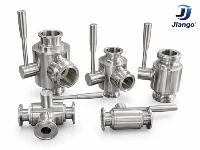
To understand the health butterfly valve and its working principle, first understand that the core focus of the health butterfly valve is ``sanitary standards,"then master the "basic operating procedures and daily maintenance points." This method is simple to operate and does not require complex technical skills. Essentially, these valves are designed for industries such as food and pharmaceuticals, requiring them to meet stringent requirements of being residual-free, easy to clean and pollution-free while controlling flow and closing.
First, clarify three core concepts of sanitary butterfly valves.
This is a prerequisite for understanding how butterfly valves work and is the key to differentiating them from normal butterfly valves:
Core focus: Hygiene Prioritizes Functionality
All design considerations revolve around "non-polluting liquids." Fluid-contaminating components (valve body and disc) must be 304/316L stainless steel and seals must be food-grade (e.g. silicone rubber, PTFE and FDA-certified). Inside, there must be no grooves or exposed threads, allowing direct cleaning using CIP (clean in place) and SIP (sterilization in place) systems to prevent contamination. Basic structure: Three Components Determine Operation
There is no need to memorize the complicated parts, only to focus on three key components:
Valve body: The main body of a connecting pipe with a smooth, circular internal flow path without a blind spot.
Valve Disc: Circular flaps that control flow through rotation -0 degrees open (parallel to current) and 90° closed (perpendicular to current).
Transmission mode: There are three kinds of manual (handle/handwheel), pneumatic (pneumatic) and electric (motor) drive. Depending on the type of driver, the operation varies.
Applicable Scenario: Only for "hygiene-critical" applications.
Mainly used in food and beverage (milk, juice), pharmaceutical (medicine solutions, pure water), daily chemical (cosmetic raw materials) industries. There is no need to avoid costly waste for general industrial applications such as sewage and chemical treatment. ii. Operational Procedures for Different Actuation Types (for beginners)
The core of the operation is to control the rotation angle of the disc. Depending on the driving method, the operating procedures vary widely. Here are three of the most common types of descriptions:
1. Manual Actuation (small aperture, low-frequency applications, such as laboratories)
This is the easiest operation, completely manual, with only three steps:
Status Confirmation: Before operation, check if valve handle is flexible, if the body is tightly connected to the pipe, and if the seal is leaking.
On/ off:
Open: Turn the handle (or handwheel) clockwise until the disc rotates to 0 (handle parallel to pipe). This allows full flow.
Close: Turn the handle counterclockwise until the disc rotates to 90° (handle perpendicular to pipe). You should feel a slight resistance. Avoid pushing too hard to break the seal.
1. Inspection Feedback: At the end of the operation, observe the piping flowmeter or pressure gauge to confirm that the piping is flowing as expected and that the seal is 2. Pneumatically Driven (large and medium production lines, such as food filling lines)
The system is driven by compressed air and requires an air source to operate. Steps:
Preliminary preparation: Open the gas source and adjust the pressure to the specified value (usually 0.4-0.6 MPa). Check the pneumatic actuator's trachea connection for leaks.
Controls on/ off:
Open: Press the "on" button (or trigger the control system signal). Compressed air pushes the the actuator to rotate the disc to 0 degrees. Valve indicator turns green.
Close: Press the "Close" button. The actuator vents and reset, rotating the disc to 90 degrees. The indicator turns red.
Status verification: use the "position indicator" (mirror or scale) on the valve to confirm that the valve disc is in the correct position. Also, check the pipes for fluid leaks.
3. Emergency Procedure: In the event of a sudden failure (such as interruption of the gas source), use the "manual emergency device" (handwheel) on the actuator to manually rotate the control disc to prevent production line from shutting down. Electric drives (Automated Workshops such as Pharmaceutical Sterile Workshops)
Driven by motor, supports remote control. Steps:
System Startup: Open valve control cabinet, make sure control system (e.g., PLC, touch screen) is not alarm, motor wiring is not loose.
Remote/Local Control:
Local control: Press the Open / Close button on the valve control panel. The screen will display the angle of rotation of the valve disc (e.g. 0-90°) and will automatically stop when the target angle is reached.
Remote control: Send commands through the workshop control system (for example, select "on" on the touchscreen). The valve automatically rotates after receiving the signal, providing real-time status feedback.
Troubleshooting: If the motor doesn't work, check the power supply and control signals first, then check to see if the the "overload protection" is triggered (reset and try again if overloaded). III. Three main considerations for daily operations (Pitfall Avoidance Tips)
Avoid excessiveoperation: stop immediately after the valve disc reaches 0° or 90 °, regardless of the type ° drive. Do not force further rotation. Manual valves can easily damage the stem, while pneumatic/electric valves can damage seals or actuators.
Cleaning takes precedence over operation: before each operation, if the valve is exposed to a workshop environment, wipe the surface of the valve body surface (especially the connector) with a sterile wipe. During production breaks, perform CIP cleaning as required (injecting cleaning fluid directly through the pipe without removing the valve) to ensure that no liquid remains inside.
If an anomaly is detected, the shutdown is immediate. If the following problems are detected during operation, the shutdown should be immediate:
Seal continues to drip (possibly due to seal aging);
viscous sensation when operating manually (possibly due to a stuck valve disc);
pneumatic/electric valves are not moving or slow (possibly due to inadequate air supply or motor failure). IV. INTRODUCTION Simple maintenance: two everyday Actionss to extend your Lifespan
Periodic inspection: weekly inspection is required. For manual valves, check that the handle is flexible; for pneumatic valves, check for air leaks; and for electric valves, check that the control signal is stable and the seal is free of distortion and damage.
Lubrication and maintenance: Apply food-grade grease to manual valve stem and pneumatic pneumatic valves the actuator bearings monthly to prevent conventional grease from contaminating fluids and ensure smooth operation.
Understanding Sanitary Butterfly Valves And Their Operation
Oct 20, 2025 Leave a message
Send Inquiry