


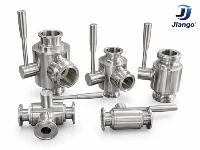

What is a Diaphragm Valve?
Diaphragm valves have been around for a long time. In ancient Greece and Rome, individuals used this type of valve to control the water temperature and flow in hot baths. The diaphragm valve was modernized in the early 1900s by a South African mining engineer, P.K. Saunders, whose company continues to manufacture these types of valves today.
Diaphragm valves are perhaps one of the most configurable types on the market, well-suited for the highly sanitary processing needs of the biotechnology and pharmaceutical manufacturing industries.Diaphragm Valves.
Versatile
suitable for use with a wide variety of fluids
Simple
contain few moving parts

Sanitary
easy to clean and maintain
Secure
feature an anti-leak seal with a tight shutoff
Diaphragm valves consist of a valve body and a flexible elastomeric membrane that combine to control the flow of a fluid. To close the valve, the membrane/diaphragm seals against a seat or weir.
Weir type diaphragm valves are the most common type of diaphragm valve. They are suitable for a variety of applications (e.g., pharmaceutical, food, and beverage applications) due to their high cleanability. They are also used in throttling applications.
Weir type diaphragm valves are the most common type of diaphragm valve. They are suitable for a variety of applications (e.g., pharmaceutical, food, and beverage applications) due to their high cleanability. They are also used in throttling applications.
The flexible diaphragm is connected to a support mechanism known as a compressor which is used to open and close the diaphragm.
When the valve is open, the diaphragm is lifted out of the fluid flow path, and the fluid has a smooth, streamlined flow passage.
When the valve is closed, the diaphragm is tightly sealed against either the seat or the weir.
The most common diaphragm valve configuration is two-port (also called a two-way diaphragm valve). Three-port or three-way configurations are also common. Much more complex configurations have multiple ports and may have more than one weir as well as more than one diaphragm and actuator. These complex configurations are used for mixing, dividing, controlling, draining, sampling, or feeding.
A significant advantage of this type of valve is that only two parts of the valve come in contact with the fluid being processed:
The valve body.
The membrane or diaphragm.

More products
Apart from the stainless steel sanitary diaphragm valve,we also produce stainless steel sanitary butterfly valves,sanitary ball valves,sanitary butterfly ball valves and sanitary union sight glasses.


