

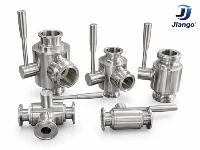


In the food, beverage, biopharmaceutical, dairy products and cosmetics industries, fluid delivery systems are more demanding in the manufacturing process. Not only to ensure the steady flow of media in the pipeline, but also to avoid pollution, residues and microbial growth. Therefore, valve equipment with high sanitary level, convenient cleaning and reliable sealing performance has become an important component of cleaner production system.
Sanitary Butterfly Valve is widely used in all kinds of clean pipeline systems because of its simple structure, flexible operation, convenient maintenance and sanitary standards.
So how does the sanitary butterfly valves work? How to achieve accurate control of clean liquids such as food and medicine? This paper will introduce the structure, working process, sealing technology and application advantages in detail.
1, Analysis of the basic structural composition and workflow of sanitary butterfly valves
Sanitary butterfly valves is mainly composed of valve body, butterfly plate, valve stem, sealing element and drive device. Compared with normal industrial butterfly valves, sanitary butterfly valves pay more attention to internal structure cleaning and fluid safety.
Its main structures include:
1. Valve Body
Valve body is usually made of food-grade stainless steel, such as 304 or 316L stainless steel.
Key features:
corrosion resistance resistance;
smooth surface;
Not susceptible to contamination;
Easy to clean and disinfect.
Due to the high proportion of nickel and molybdenum elements, 316L stainless steel has been widely used in medicine and biology, making it more prominent in acid resistance, alkali resistance and chemical corrosion resistance resistance.
2. Butterfly board
butterfly plate plate is the core component of fluid flow control.
As the butterfly plate rotates, the fluid channel area can change:
When the butterfly plate is parallel to the direction of the pipe, the valve is fully open.
The valve is completely closed when the butterfly plate rotates 90 degrees.
When the butterfly plate is in the middle, a certain flow regulation can be achieved.
The butterfly plate structure is simple, the opening and closing speed is fast, is very suitable for production environments which requires frequent operation.
3. Valve stem
The stem is responsible for connecting the drive device to the butterfly plate.
The butterfly butterfly plate power through the valve stem and rotates at a set angle to achieve fluid control.
High-quality sanitary butterfly valves usually use finely machined stem to ensure:
Steady rotation;
Flexible operation;
Reliable sealing.
4. Sealed components
The sealing structure is the key to the clean control of sanitary butterfly valves.
Common sealing materials include:
(a) Triethylene propylene rubber;
Polytetrafluoroethylene;
FKM et al.
Different materials have different properties:
EPDM has good properties of resisting steam and food media.
PTFE (PTFE) has strong chemical corrosion resistance.
FKM is suitable for high temperature and special media environment.
Reasonable selection of sealing material can improve valve service life and avoid fluid contamination.
2. The working principle of sanitary butterfly valve.
Sanitary butterfly valves mainly realizes fluid opening/ closing control by the rotation movement of butterfly plate.
The specific workflows are as follows:
1. Opening process
When the operator activates the handle or pneumatic actuator, power is transferred to the butterfly plate through the valve stem.
Butterfly board begins to spin:
Gradually opening from a closed position;
Increased area of fluid channels;
The medium begins to flow.
When the butterfly plate is in the same direction as the pipe, the fluid resistance is minimal and the maximum flow is achieved.
2. Closure process
When closed, the drive drives the valve stem to rotate in the opposite direction.
butterfly plate plate gradually blocks the flow channel, tight the sealing ring.
The final form:
Complete isolation;
Prevention of media leakage;
Ensure production safety.
3. Flow control procedures
In addition to opening and closing completely, sanitary butterfly valves can also regulate flow rate by controlling the angle of the butterfly plate.
For example:
Small angle opening: Reduced traffic;
Medium angle opening: Control the conveying speed;
Wide open: Increased traffic.
Therefore, sanitary butterfly valves can not only be used as a cut-off valve, but also meet certain process adjustment requirements.
3, How do sanitary butterfly valves ensure fluid cleanliness through sealing techniques?
In a cleaner production environments, the biggest challenge for valves is not simply to control flow but to prevent contamination.
Sanitary butterfly valves mainly realizes cleaning control through the following techniques:
1. Structural design has no dead angle;
Ordinary valves may have grooves or fluid buildup inside, which can easily lead to:
Residual media;
Bacterial growth;
Cleaning is difficult.
The sanitary butterfly valve adopts optimized flow path design, makes the interior smoother, reduces the liquid retention areas.
This can improve:
Cleaning efficiency;
Disinfection Effect;
Safe production.
2. High precision sealing design
Sanitary butterfly valves is securely sealed by the tight cooperation between the valve seat and the butterfly plate.
A high-quality sealing system can:
Preventing the entry of foreign pollution;
Prevention of leakage of internal media;
Keep the pipes clean.
3. Support CIP online cleaning.
CIP (Cleaning in Place) online cleaning technology is widely used in the food and pharmaceutical industries.
Sanitary butterfly valves Adaptable to CIP processes:
cleaning solution in the pipe;
Removal of residues;
Reduce the need for manual disassembly.
This not only increases productivity, but also reduces the risk of human pollution.
4. Health butterfly valves in the food, medicine, biology and other industries application advantages.
1. Food processing industry
Food production requires extremely high sanitary standards.
Sanitary butterfly valves are commonly used for:
Milk conveying system;
Beverage production line;
Juice processing equipment;
Sauce production equipment.
Advantages include:
Prevention of food contamination;
Easy to clean
Compliance with hygiene production requirements.
2. Pharmaceutical industry
Drug production requires strict control over a clean environment.
Sanitary butterfly valves are used for:
Drug delivery;
Pure water purification system;
Biological reaction equipment;
Filling line.
Its high cleanliness performance can help companies meet strict production standards.
3. Bioengineering industry
In the biological manufacturing process, there are very strict requirements for fluid environment.
Sanitary butterfly valves ensure that:
Pipeline cleanliness
Moderate stability;
Reduce cross contamination.
5, How can pneumatic control and automation technology improve the performance of sanitary butterfly valves?
With the development of intelligent manufacturing, more and more sanitary butterfly valves adopt automatic control methods.
Among them, pneumatic sanitary butterfly valves has been widely used.
Its working methods are:
Control system sends signals;
Pneumatic actuators generate electricity;
Drive the stem to rotate;
Complete valve opening or closing.
Compared with manual operation, automatic control has the following features:
Respond quickly;
More precise operation;
Suitable for continuous production;
Easily centralized.
Some smart health butterfly valves can also be configured to:
Valve position feedback device;
Smart locators;
Automatic monitoring system.
To help enterprises realize digital management of production process.
6. What are the key parameters to consider when selecting a sanitary butterfly valve?
When purchasing sanitary butterfly valves, enterprises should focus on the following factors:
1. Material needed
Based on media environment selection:
304 stainless steel;
316L stainless steel.
If liquid drugs or acid-base media are involved, it is recommended to select materials with good corrosion resistance.
2. Sealing material
Need to be based on:
working temperature;
chemical property;
Cleaning methods;
Choose a suitable sealing ring.
3. Connection method
Common methods to connect are:
Clamp connection;
Welding connection;
Threaded connection.
The food and pharmaceutical industries tend to focus more on the convenience of disassembly and cleaning performance.
4. Work pressure and temperature
Before you buy, make sure:
Maximum work pressure;
working temperature range;
Fluid characteristics.
Ensure the valve can operate steadily for a long time.
Conclusion:
The sanitary butterfly valve realizes reliable control of clean fluid system through butterfly plate rotation control, precision sealing structure, sanitary grade material and no dead corners design. Compared with common industrial butterfly valves, sanitary butterfly valves pays more attention to pollution prevention, convenient cleaning, long-term stable operation, is an important fluid control equipment in food, beverage, medicine, biotechnology and other fields.
With the development of automatic production and intelligent manufacturing, pneumatic control, on-line detection, intelligent valve and other technologies will further enhance the application value of sanitary butterfly valves. For enterprises that need to ensure product safety, improve production efficiency and conform to strict hygiene standards, choosing the proper sanitary butterfly valve can not only optimize the production process, but also provide important guarantees for long-term stable operation.
How Does The Sanitary Butterfly Valve Work? How To Control Water Purifiers?
Jul 01, 2026 Leave a message
Send Inquiry