

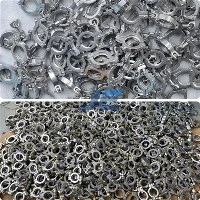


1. When sanitary pipe fittings are rusted due to adhesion of dissimilar metals
If there is "incidental rust" caused by iron powder, etc. or if the situation is not serious, you can easily remove the rust by wiping it with a sponge or cloth and a neutral detergent or soapy water. Then rinse with clean water, being careful not to leave any cleaning solution on it. This level of rust removal is not only easier to maintain and more effective as long as the removal work is done immediately, but the removal cost is also very cheap.
But if you leave it alone, a mixture of iron hydroxide, iron oxide, iron sulfite, etc. will form soon, and appear in a dark brown state of severe rust. In this case, you can use commercially available stainless steel cleaning solution or 15℅ diluted nitric acid to completely remove it. However, there is also rust that cannot be removed, and it will also damage the stainless steel surface to some extent or damage the stainless steel. At this time, use sandpaper or a stainless steel brush to grind and wipe it, and then clean it with cleaning solution.
2. Rust caused by sanitary pipe fittings adhering to harmful components in exhaust gas
In factory areas or in urban areas with heavy traffic, the surface of stainless steel is easily contaminated, and sometimes small spots of rust may appear. Most of these conditions are caused by the harmful components contained in the exhaust from cars, air conditioners and heaters, or factory exhaust.
At this time, when the pollution is minor, neutral detergent or soapy water can be used to completely clean it, but when it is serious, it is not easy to deal with. In this case, the same maintenance method as in the previous item 1 can be used to clean it. In this environment, it is best to conduct comprehensive regular cleaning of the surface 2-3 times a year, and at least one regular cleaning is absolutely necessary.
3. Sanitary pipe fittings will rust due to salt adhesion
When exposed to sea breeze in coastal areas, SUS 304 stainless steel will also develop red rust in a short period of time. Moreover, it rusts faster than other areas, and the treatment method is the same as in case 1. Coastal areas hope to use SUS 316, which is more corrosion-resistant, as stainless steel when adopting stainless steel exterior decoration. As for using SUS 304 as stainless steel exterior, regular cleaning should be done 3-4 times a year as much as possible.
4. Rust caused by cleaning liquid adhering to sanitary pipe fittings
If it cannot be removed with neutral detergent, use cleaning solution.
5. Sanitary pipe fittings rust due to hand dirt or fingerprints
If it cannot be removed with neutral detergent, wipe it with a sponge, cloth, etc. dipped in an organic solvent (alcohol, light oleyl alcohol, acetone, etc.). If this method still cannot completely remove it, use stainless steel cleaning solution to remove it. In short, after cleaning with various cleaning methods, you must rinse with water again.
How To Maintain Sanitary Stainless Steel Pipes
Jan 01, 2024 Leave a message
Send Inquiry