

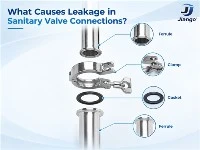



Sanitary butterfly valve works in the clean pipe for a long time. It needs acid and alkali cleaning, high temperature disinfection and material immersion. Seals are consumables, and leaky seals and aging rubber ring are the most common problems. Once the valve leaks, it will not only cause material loss, but also cause cross-contamination, which directly affects the cleanliness verification of food and drug production lines. Many workshops replace parts after water leakage, lack regular maintenance, and glitches turn into outages. This paper summarizes the typical causes of health butterfly valves malfunction, and describes maintenance methods suitable for CIP and SIP processes.
Seal leakage: Sanitary butterfly valves is most likely to malfunction, there are two types of leakage: internal leakage and external leakage.
There are two kinds of leakage of sanitary butterfly valves: media leakage and valve leakage. Leakage refers to material leakage in valve body, valve stem, clamp joints, etc., which is visible to the naked eye. Leakage refers to the situation where the media in upper and lower pipe are still connected after the valve is closed, making it difficult to detect from the outside, often causing greater harm.
Leakage is mainly due to inadequate rubber ring compression, loose clamp or the sealing ring surface scratches. Particle impurities and crystalline materials in production pipeline can easily scratch the surface of the sealing gasket when passing through the valve, forming small scratches and damaging the surface of the sealing gasket. The common causes of internal leakage are improper closing of butterfly plate, insufficient torque of actuator, or aging of rubber ring, rebound, butterfly plate still has gaps after compression. Many operators will directly replace rubber ring when there is a water leakage, but do not clean the seal of impurities. The new rubber ring would leak again soon after being installed.
Rubber ring aging and failure: high temperature, acidity, alkalinity and compression are the main causes of aging and failure of rubber ring.
Seal ring is the core of sanitary butterfly valves, commonly used materials such as EPDM, silicone, PTFE, and so on, have corresponding temperature tolerance and medium range. Repeated exposure to CIP acid-base flushing and SIP high-temperature steam sterilization are the main factors that accelerate the aging of rubber rings. Long-term high temperature will make rubber elastic, hardening, brittle, cracking; long-term erosion by acid-base media, rubber rings will expand, soften, deformation.
In addition, if the valve is closed and compressed for a prolonged period of time, the rubber ring will continue to be compressed, causing permanent deformation, which is known as compression permanent deformation. Even if the butterfly plate is released, the rubber ring cannot rebound and recover. When choosing a rubber ring, the aging rate will double if the material of the ring does not match the conveyor medium, such as using common silicone rubber to deliver strong acidics and alkali drugs. Aged rubber rings can appear white, cracked, sticky and flaky on the outside. Mixing these pieces with materials can lead directly to substandard products.
3. Other typical glitches that tend to go unnoticed.
The sanitary butterfly valves has several high frequency faults in addition to sealing and gasket problems. Drive mechanism jamming is a common problem in automation valves. The pneumatic actuator air source contains oil and water, and water vapor enters the interior, causing piston corrosion and action jamming. Electric actuators is exposed to steam for a long time, causing water vapor to seep into the housing, causing motor and limit failures.
In addition, the butterfly plate rotates incorrectly and the handle or actuator indicates that it was closed correctly. However, the butterfly plate did not quite match the sealing seat, causing an internal leakage. Sealing the valve stem position is damaged and the material seeps through the valve stem gap into the executive end, not only leaking media, but also corroding the drive components. In addition, fixture deformation, valve body polishing surface wear, pipeline dislocation, etc. will indirectly lead to uneven sealing force, accelerate rubber ring damage.
4, Daily inspection: Discover potential problems before they occur.
Clean room should set up valve inspection mechanism, do not need to wait for obvious water leakage before processing. The first step in the inspection process is to visually inspect the valve body, clip and valve stem for leakages or residual crystallization; open and close the valve to ensure that the butterfly plate rotates smoothly at 90 degrees without interference or abnormal noise.
For pneumatic butterfly valves, observe whether the opening and closing speed is stable, slow or intermittent movement, check feedback from the electric valve to confirm that the valve position is consistent with the central control signal. After the CIP and SIP processes are complete, the valve sealing position must be inspected to remove any residual acid-base crystals that may continue to corrode the rubber ring. It is necessary to blow the exhaust valve in time. For long-closed sample and bypass valves valves, regular opening and closing tests should be conducted to avoid failure of rubber ring due to long-term unidirectional compression and shaping.
5. Standardised maintenance and replacement of fittings.
The core principle of maintenance is to minimize unnecessary damage to seals. When removing and assembling valves, it is prohibited to use sharp tools to scratch the sealing surface and rubber ring; before replacing rubber ring, the sealing grooves and butterfly plate edges of the valve body should be cleaned to remove crystals and debris. The new rubber ring shall be installed in such a way as to ensure no deformation or compression, and the fixture shall be uniformly locked to avoid one-way forces.
Replacement fittings must use sanitary grade seals and seals of the same material, general rubber rings cannot be used casually as a substitute. Synchronize the maintenance of the actuator, install the gas source treatment triplets in the pneumatic system, and regularly drain and remove oil; Electric actuators should be well protected from direct steam spraying. After maintenance is complete, a leak test is required to confirm that there was no internal or external leak prior to production. In sterile conditions, maintenance records are required to meet GMP traceability requirements.
In summary, most of the health butterfly valves failures are concentrated the sealing system, rubber rings aging is a normal loss, can be predicted and controlled. Regular inspection, specification of CIP/SIP process conditions, selection of dielectric compatible sealing materials, and periodic replacement of rubber rings can significantly reduce leakage failures, ensure stable operation of clean pipes, and avoid material pollution and downtime losses.
Seal Leakage And Aging? Common Faults And Maintainments Of Sanitary Butterfly Valves
Oct 30, 2026 Leave a message
Send Inquiry