

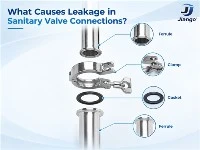



CIP online cleaning is the core of product product safety pharmaceutical, dairy products and fruit juice cleaning lines. Instead of removing pipes and valves, it relies on an acid-base cleaning solution and hot water circulation to flush the inner walls for cleaning and disinfection. Ordinary industrial butterfly valves have many internal cavities and gaps, cleaning solution cannot be completely rinsed into place. Residual materials are susceptible to microbes, and sanitary butterfly valves are designed with no retention around CIP requirements, from valve body and butterfly plate to seal and valve stem. Many purchasing and operating staff only know that it supports online cleaning, but it is not clear how it achieves a seamless flush structure. This paper analyzes its underlying design logic.
1. What is the true "no dead corners" requirement for CIP cleaning valves?
Dead angle is where the cleaning fluid cannot be continuously rinsed and the medium is prone to stagnation and accumulation. In hygiene standards such as GMP, 3A, EHEDG, clean pipeline valves must eliminate blind cavities, grooves, blind steps, and narrow gaps as much as possible to ensure that all surfaces that come into contact with materials are flushed steadily with a cleaning solution and any accumulated fluid is discharged smoothly after cleaning.
The CIP design goals of sanitary butterfly valves is twofold: first, when the valve is fully opened, the inner diameter of the fluid channel and pipe is basically flushed clean, the cleaning medium flows smoothly and the flow rate is stable; secondly, after washing, the accumulated water can flow naturally without any residual water being formed by the a self draining structure. The dead-end here is not an absolute zero gap, but a dead end without fluid retention. During cleaning, the cleaning solution can cover all wet surfaces, avoid long-term adhesion of materials and biofilms, and prevent cross contamination of different batches of materials.
Valve body streamlined piping and self-draining structure eliminates foundation retention area.
The valve body is the foundation of CIP design, most sanitary butterfly valve body is finely forged or cast, no ordinary butterfly valves inside the wide cavity. The contour of the inner cavity transitions smoothly, with no sudden steps or grooves. The inner wall of the pipeline is polished with a mirrored or matte finish to reduce surface roughness and minimize the amount of material adhesion to the wall.
At the same time, the valve body has a self-drainage design that allows for a slight tilting of the pipe during installation. Residual liquid in the valve body can be completely drained along the curved surface without creating a puddle at the bottom. Connection methods can also be used for cleaning purposes. Mainstream clamping fast installation structure has a flat and aligned sealing surface, and unlike flange connections, flange connection has multi-layer gasket gaps, avoiding dirt accumulation in the gap. The inner wall of the valve body and pipeline joint is flush, and there are no no misaligned steps to block the flow of cleaning fluid, ensuring continuous stability of the cleaning flow field.
3, The centerline butterfly plate adopts the integration valve seat seal, avoids sealing the blind spot.
Most sanitary butterfly valves have a middle-line soft seal structure, butterfly plate is located in the center of the pipe, rotated 90 degrees to achieve opening and closing. The edge of butterfly plate is tightly fastened to the sanitary sealing seat. The seal seat is embedded inside the valve body. The contact surface is smooth and no protrusion or groove is installed.
butterfly plate are also polished. When the butterfly plate is fully open, lay the butterfly plate flat. The cleaning solution can clean the front and back of the butterfly plate at the same time. Many common butterfly valves have deep sealing grooves that easily accumulate material, while sanitary butterfly valve seats have a smoothly-wrapped structure that reduces material gaps. Acetyl-resistant and high temperature sanitary rubber materials such as EPDM, silicone rubber, polytetrafluoroethylene (PTFE), can be repeatedly acetyl-resistant and SIP high temperature steam sterilization. It is not easy to dissolve harmful substances, and it is not easy to age and crack quickly to form voids.
4. valve stem adopts a sterile sealing structure to solve blind spot which is easy to be ignored.
The opening position of the stem is the most easily overlooked cleaning blind spot in many sanitary valves. Normal butterfly valves stem and valve body between a large gap, materials easy to penetrate the gap, making CIP cleaning solution difficult to enter, causing long-term accumulation and deterioration.
The sanitary butterfly valve adopts a multi-layer sanitary grade sealing structure, specially optimized for this position. Some models have corrugated pipe seals that completely isolate the medium from the external drive area and prevent material from seeping into valve stem gap. The connection between valve stem and butterfly plate adopts a smooth transition structure with few exposed connection structures and no exposed screw or pin pits, eliminating the stagnant area at the connection point. During the cleaning cycle, the cleaning solution that flows through the valve stem area can continuously flush the contact surface without forming an enclosed dirt storage space, which is also a key design to meet sterile conditions.
5, The correct use of valves in CIP cleaning process can achieve structural advantages.
Even the best structures require proper cleaning operations. During CIP implementation, the sanitary butterfly valve needs to remain fully open so that the cleaning solution passes through the valve channel completely, thoroughly rinsing the front and back of the butterfly plate, sealing cover, and valve stem area. If the valve is partially opened or closed for cleaning, the butterfly plate will block the flow and the rear area will not be cleaned enough, resulting in inadequate cleaning.
At the same time, the flow rate, temperature, acid-base concentration, etc. of the cleaning solution should also conform to the norms, and accessories should be removed according to the washing force of the cleaning solution. Valve construction can only provide basic cleaning conditions and cannot replace the standard CIP process. After long-term use, the sealing gasket will age and deform, with small gaps. It needs to be regularly disassembled, inspected and replaced to maintain its ability to prevent blind spots.
In general, the sanitary butterfly valves adapts to CIP cleaning not as a simple material upgrade, but as a systematic fluid hygiene design: a smooth self-draining valve body eliminates puddles of fluid, a the centerline butterfly plate and flat-slip slide valve reduce sealing dead angles, a stem sterile seal blocks hidden blind spots, and polished surfaces reduce material adhesion. Understanding this design principle is critical to selecting truly compliant sanitary butterfly valves, avoiding off-label butterfly valves that look similar but have dead ends inside, and ensuring consistent compliance with cleaning and validation requirements cleaner production in food and pharmaceutical industries.
Blind Spot CIP Cleaning? Understand The Design Principle Of Sanitary Butterfly Valve.
Oct 10, 2026 Leave a message
Send Inquiry