

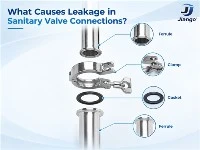



In cleaner production workshops such as dairy products, beverages, pharmaceuticals and bio-fermentation, the raw materials and liquid medicines used in pipeline transportation require high levels of cleanliness. Due to the indoor dead-angle, the general industrial valve cannot be used, easy to accumulate materials, breeding bacteria. Sanitary butterfly valve is specially developed for cleaning piping. It has the advantages of simple structure, smooth flow channel and convenient cleaning and disinfection. It has become a kind of switch valve widely used in clean fluid pipe. A lot of first-time butterfly valve users will confuse it with a normal butterfly valves. In this paper, the definition, structure, characteristics and application of sanitary butterfly valves are introduced in detail.
Basic definition of sanitary butterfly valve: special butterfly valve for cleaning working conditions.
Sanitary butterfly valves are a subclass of butterfly valves often called food-grade butterfly valves or quick-release butterfly valves. Its core function is to control the flow of fluid through clean pipes, and some models can be used to roughly adjust the flow. The main difference between this valve and normal pipe butterfly valve is that all components in contact with media meet sanitary design standards. The main design objective is to reduce residue and facilitate cleaning.
Ordinary butterfly valves has concave and convex cavities and gap inside, the material hidden in the gap is difficult to clean. Prolonged residue can spoil and contaminate the next batch. The sanitary butterfly valve is optimized from valve body cavity, butterfly plate to sealing cover. It is designed to be smooth and residual-free. It is suitable for the CIP online cleaning and SIP online sterilization processes. That's the fundamental reason it's been able to get into the food and drug business.
2. The core structure is made up and every design revolves around cleanliness requirements.
The overall structure of sanitary butterfly valve is not complicated, mainly composed of valve body, butterfly plate, rubber ring, valve stem, drive device and so on. Valve body is mainly made of stainless steel and the inner wall is polished to reduce material adhesion. The circular butterfly plate in the middle is the opening and closing component and can be rotated 90 degrees to fully open or close. The sealing element surrounding the outer edge of the butterfly plate is the key to insulate the medium and preventing leakage.
A dead-angle seal is usually used between stem and valve body to prevent media penetration into valve stem gaps and residues. Transmission form can be matched with manual handle, pneumatic actuator or electric actuator, suitable for manual operation and automatic production line. The most common type of structure on the market is a clamp fastening, which requires no welding or a large number of bolts to be removed and assembled. By removing the fixture, the valve can be removed quickly, making it easy to remove, clean, maintain and replace the seal ring offline.
3, What are the main differences between sanitary butterfly valves and ordinary industrial butterfly valves?
A lot of times it's easy to fall into traps when buying, so the butterfly valves is usually used directly, rather than sanitary butterfly valves, which can lead to problems such as excessive microbes and spoilage of materials at a later stage. The first difference between the two is material. The main materials of sanitary butterfly valves are 304 stainless steel and 304 and 316L stainless steel, which meet the requirements of food exposure and FDA and 3A hygiene certification. They are acid and alkali resistant and do not easily produce harmful substances. Ordinary butterfly valves are usually made of cast iron, carbon steel or ordinary stainless steel.
Then there is the design of flow channels. The inner cavity of the sanitary butterfly valve is basically flush with the inner diameter of the pipe. When the valve is fully open, the fluid channel is unobstructed, and there is almost no dead angle of material accumulation. Ordinary butterfly valves body has many concave and convex structures, which make the medium easy to accumulate. There are also surface treatments. The interior of the sanitary butterfly valve will be polished with a mirrored or matte finish to reduce adsorption. The inside of a regular butterfly valves is rough and easy to hang. Sealing elements are different. Sanitary butterfly valves are usually sealed with sanitary grade rubber materials such as silicone rubber, EPDM, fluoride rubber, and so on, which have high temperature sterilization resistance properties, while ordinary butterfly valve sealing materials do not meet cleanliness standards.
4, What production lines are sanitary butterfly valves suitable for mainstream application scenarios?
Sanitary butterfly valves is mainly used for fluid piping which doesnot contain material residues and requires to be cleaned and sterilized regularly. In the food industry, pipelines carrying fresh milk, fruit juice, beer, syrup and soy sauce are widely used for purified water, injection water, drug formulation and raw materials in the pharmaceutical industry, as well as for fermentation liquid and media in the biological industry, and for cleaning pipeline of refined and lotion in the chemical industry.
It is more suitable for clean water, solutions and low viscosity liquids. For medium with high viscosity and many solid particles, the sealing surface is easy to wear, so caution should be exercised when selecting. At the same time, sanitary butterfly valve seals belong to the midline soft seal, limited pressure bearing capacity, mainly for low pressure cleaning pipe, not suitable for high pressure working conditions.
5. The basics of daily use and choice.
When selecting, prioritise medium, temperature and pressure, then select the matching valve body material and sealing ring material. For example, in the case of high temperature disinfection, it is advisable to use temperature resistant EPDM sealing rings; priority should be given to the use of 316L valve bodies for the transport of acidic and alkaline drugs. After installation, it is necessary to inspect the sealing gasket regularly. The gasket will age and deform after long cleaning and high temperature disinfection. If a leak occurs, it should be replaced in a timely manner.
In daily production, sanitary butterfly valve mostly adopts CIP cleaning processes, flushes the pipe and valve interiors online, reduces the number of manual disassembly. While it supports online cleaning, it recommends regularly removing and inspecting the material adhesion of the cavity after a long period of production to ensure a stable cleanliness indicators.
In general, sanitary butterfly valves is not just switch valve, but also an important component of cleaner production system to ensure product safety. By using non-quality sanitary structure and qualified material, the sore point of accumulation and contamination of common valve material is solved. Understanding its design logic and scope of application can avoid misunderstanding when choosing clean piping and meet the requirements of cleaning and disinfection of production line.
What Is A Sanitary Butterfly Valve? Science Popularization Of Special Valves For Food And Drug Cleaning Pipeline
Oct 01, 2026 Leave a message
Send Inquiry